Warrinh - Bunurong Land Country and Sea Country

Bunurong peoples have lived in Mornington Peninsula Shire area for thousands of years and hundreds of generations. The cultural and biocultural landscapes of Bunurong Country continue to hold significance for Bunurong peoples today. From Naarm (Port Phillip Bay) in the east, Wurnmarrinh (Western Port Bay) in the west and south to the shores of Bass Strait, Mornington Peninsula Shire is part of Bunurong Country that is home to many culturally meaningful places including Munmurr (Point Nepean), Darrmgurrk (Cape Schank) and Wanggu (Arthurs Seat).
Mornington Peninsula Shire is defined by its relationship to saltwater, and this is true too of Bunurong peoples whose connection to Country–Land, Sea and Sky–is vast and enduring.
Munmurr
Munmurr (Point Nepean) is one of the most significant places on Bunurong Country. Bunurong Elder Aunty Gail Dawson tells us that towards the tip, where the peninsula narrows to a point, is a ceremonial place only for women. The men are not allowed here, and they have their own ceremonial place along a nearby ridgeline. Munmurr is also a place of great sadness and injustice for Bunurong peoples, as it was from here that Bunurong women were kidnapped by sealers while walking along the beach.
Darrmgurrk
Darrmgurrk (Cape Schank) is another significant place on Bunurong Country. It is where men’s business was and continues to be practiced today. When you overlook the choppy waters of Bass Strait, you are standing where Bunurong Land Country and Sea Country meet. Today, Bunurong peoples proudly identify as warrinh (saltwater) people and waterways, both fresh and marine, define the boundaries of Bunurong Country.
Wanggu
Wanggu (Arthurs Seat) is visible from many places throughout Bunurong Country, including across the vast stretches on Naarm. It is an important meeting place where corroborees would take place, with men, women and children all holding corroborees here. During a corroboree, a fire would be lit and surrounding it the sounds of singing, dancing and clanging weapons could fill the air for an entire night.

The Plants of Bunurong Country
Country has inextricable links with culture, people and all living things and Bunurong peoples have been sustained by Country and the multitude of plant resources it provides. Bunurong peoples use warawarap (Black Wattle; Acacia mearnsii), bulayt (Cherry Ballart; Exocarpos cupressiformis) and binap (Manna Gum; Eucalyptus viminalis) in cleansing ceremonies. Warawarap is strong and enduring, representing the men of the community. Bulayt cannot survive without obtaining nutrients from a host plant, representing youth. Binap represents the Bunurong women who nurture and care for people and Country.
Tread lightly as you walk on Bunurong Country. All elements of Land, Sea and Sky Country are important. As you care for Country, Country will care for you.
The knowledge, information and text contained in this page must not be reproduced without prior explicit written permission from BLCAC. It remains the Intellectual Property and Copyright of BLCAC.
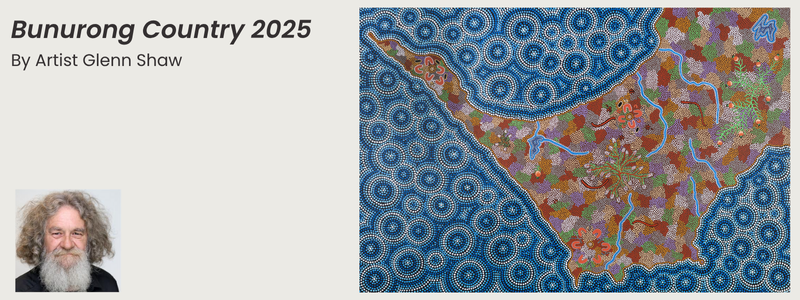
Artwork: Bunurong Country 2025 by Glenn Shaw
Artist profile - Glenn Shaw
Glenn is a proud Bunurong (Victoria) Trawlwoolway and Plangermairreenner (Tasmania) Aboriginal man, strongly connected to Community and Culture. Glenn was born on Flinders Island, Tasmania in 1958 and started painting as a teenager.
Glenn paintings are contemporary with using a traditional style and depict his perspective of traditional stories or cultural activities from his personal life and experiences as well as stories passed down to him. Glenn has developed his unique art style by learning from other artists not only in Tasmania, but also from the many years he lived and worked in the Kimberley, Western Australia.
Glenn is extremely respectful of the various art styles and stories across Australia and does not paint stories which do not hold cultural or personal significance to him and will not paint or tell a story which he does not have the cultural ability or permission to do so.
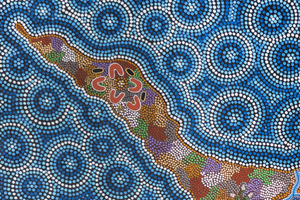
This artwork tells the story of three specific places in Bunurong Country and specifically Munmurr, Darrmgurrk and Wanggu. It also represents the traditional foods gathered y Bunurong people while they moved through and occupied the special places.
Visit our Mornington Peninsula Shire Aboriginal and Torres Strait islander culture on the Peninsula page:

